











Key takeaways
- NST was founded in 2023, so it doesn't yet appear in long-standing frameworks like NIRF — newer institutions typically take years to qualify and feature.
- This absence isn't a verdict on quality; it largely reflects how young the institution is.
- NST is better judged on outcome-based signals: internship rates, competitive-programming results, and student achievements.
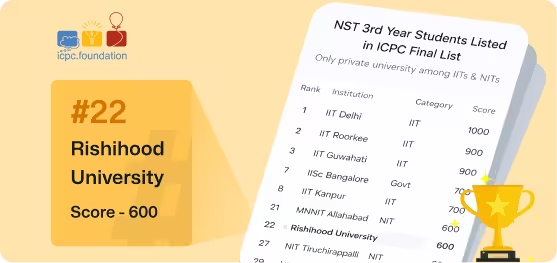
- Notable signals include a 22nd national rank at ICPC Chennai Regionals (ahead of several established institutions), GSoC selections, and ~93% of students interning by year 2.
Why traditional rankings don't tell the full story here
Most well-known Indian college rankings — NIRF being the most prominent — weigh factors like teaching resources, research output, graduation outcomes, and perception, accumulated over many years. By design, they favour institutions with a long operating history and multiple graduated batches.
NST was founded in 2023. It simply hasn't existed long enough to have the multi-year track record these frameworks require. So if you search for "NST NIRF ranking" and come up empty, that's expected — and it says far more about the institution's age than its quality. Judging a two-year-old institution by frameworks built for decades-old ones isn't a fair test.
This cuts both ways, and it's worth being clear-eyed about it: the flip side of "too new to be ranked" is "too new to have a long, proven alumni and placement history." A genuinely balanced view holds both facts at once.
A fairer lens: outcome-based signals
If conventional rankings don't yet apply, what should you look at? For an outcome-driven institution, the most meaningful evidence is what students actually achieve. On that score, NST has accumulated some notable signals.
Competitive programming (ICPC)
ICPC is often called the "Olympics of coding," and it's a tough, objective benchmark. An NST third-year team secured a 22nd rank nationally at the ICPC Chennai Regionals 2025 — competing against top teams from IITs, NITs, and IIITs, and finishing ahead of several established institutions as well as ranking among the top private colleges in India. NST has also reported moving a foundation batch into the ICPC Asia West stage, a level only a small fraction of competitors reach.
Google Summer of Code (GSoC)
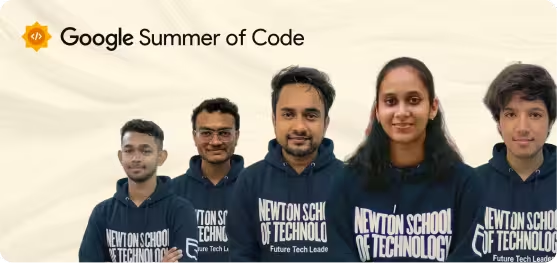
Multiple NST students have been selected for Google Summer of Code, a globally competitive open-source program — a meaningful indicator of individual technical capability.
Internship outcomes
NST reports that ~93% of students secured a paid internship by their second year, at an average stipend of ₹23,066, with data certified by B2K Analytics, IIM Ahmedabad's placement auditors. Independent verification matters when assessing any institution's claims.
Recognition and collaborations
NST students have featured in national-level achievements — including projects recognised in connection with government and research bodies — and the institution has collaborations with IIT Roorkee and ISRO. These don't substitute for a formal ranking, but they're credible, externally validated markers.
How to evaluate NST for yourself
Rather than waiting for a ranking that's structurally years away, a prospective student or parent can run their own due diligence:
- Look at verified outcomes — internship rates and stipends (ideally audited), not just brochure claims.
- Examine the curriculum — does the build-first, AI-native structure match where the industry is heading?
- Check the degree's recognition — NST's B.Tech is UGC-recognised and awarded by partner universities (Rishihood, ADYPU, S-VYASA, St. Mary's).
- Talk to current students — their day-to-day experience is more informative than any single metric.
- Weigh the trade-off — an industry-aligned, modern model versus the established track record of older institutions.
A fair, balanced conclusion
It would be misleading to claim NST "out-ranks" established colleges — the data to make that comparison through traditional rankings simply doesn't exist yet. It would be equally misleading to dismiss NST for lacking a ranking, when that absence is a function of its age, not its quality. The fairer read is this: NST is a young, outcome-focused institution whose early, externally validated signals — ICPC results, GSoC selections, audited internship outcomes, and a recognised degree — are genuinely strong for its age. Whether that's the right choice for you depends on how much you value an established brand versus a modern, industry-led model. Evaluate the evidence, weigh the trade-offs, and decide based on your own priorities.
Frequently asked questions
What is NST's NIRF ranking? NST, founded in 2023, is too new to appear in NIRF, which requires a multi-year operating history. Its absence reflects its age rather than its quality.
Is Newton School of Technology a good college? That depends on your priorities. NST shows strong early outcome signals — ICPC results, GSoC selections, and audited internship rates of ~93% by year 2 — but lacks the long track record of older institutions.
How can I judge NST without a ranking? Focus on outcome-based evidence: verified internship and stipend data, the curriculum's industry alignment, the degree's UGC recognition, and feedback from current students.
Is the NST degree recognised? Yes. The B.Tech is UGC-recognised and awarded by NST's partner universities.
The bottom line
NST is best evaluated not by a ranking it's too young to have, but by what its students are already achieving and the recognised degree they earn. Use outcome-based evidence and your own priorities as your guide — that's a fairer measure for any new-age institution.
This article is intended to be balanced and informational. Verify current outcomes, recognitions and any ranking developments on official sources. Last updated: June 2026.