








Key takeaways
- NST's faculty are drawn from IISc, the IITs, and global PhD programs.
- Teaching is paired with mentors who have held senior roles at Google, Microsoft, Amazon, Adobe, and Goldman Sachs.
- The model deliberately blends academic rigour with real industry experience — addressing a gap NST's founders saw at premier institutions.
- Mentorship is continuous, not occasional, and tied to hands-on, project-based learning.
The thinking behind NST's faculty model
NST's founders, Nishant Chandra and Siddharth Maheshwari, are IIT Roorkee batchmates who noticed a recurring problem even at elite institutions: much of the learning was theoretical, many professors lacked direct industry experience, and graduates often struggled to translate their education into meaningful work. As Maheshwari has put it, professionals in industry often succeed despite the education system rather than because of it.
That observation shaped NST's approach to who teaches. The goal isn't only academic depth — it's the combination of strong fundamentals and the lived experience of building real software at scale.
Two pillars: academic faculty and industry mentors
Pillar 1 — Academic faculty from top research institutions
NST's teaching faculty are drawn from premier research backgrounds, including the Indian Institute of Science (IISc), the IITs, and global PhD programs. This group anchors the rigorous foundations of the program — the mathematics, algorithms, data structures, and theory that underpin everything from machine learning to system design.
This matters because shortcuts in fundamentals show up later as ceilings on a student's ability. Strong academic faculty ensure the "why" behind the code is taught properly, not just the "how."
Pillar 2 — Industry mentors from leading tech companies
Running parallel to the academic faculty is a network of mentors who have held senior roles at companies such as Google, Microsoft, Amazon, Adobe, and Goldman Sachs. These practitioners bring current, real-world context: how production systems are actually architected, how engineering teams operate, what interviewers look for, and how the industry is shifting in real time.
In NST's own words, the aim is to bring the tech industry into the classroom so learning stays practical, current, and impactful — students don't just learn theory, they build, innovate, and solve real problems with guidance from people who've done it professionally.
How mentorship shows up day to day
NST's mentorship isn't a one-off guest lecture series. It's woven into a build-first curriculum where students:
- Work on real-world projects modelled on industry problems from the first year.
- Receive continuous feedback from mentors as they build, not just at exam time.
- Get guidance on internships and placements from people connected to hiring teams.
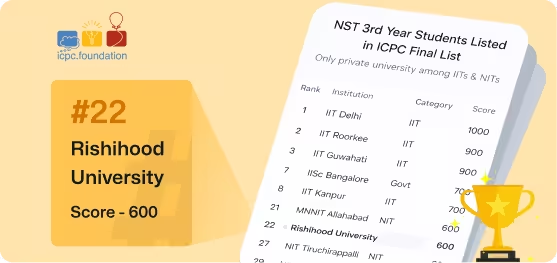
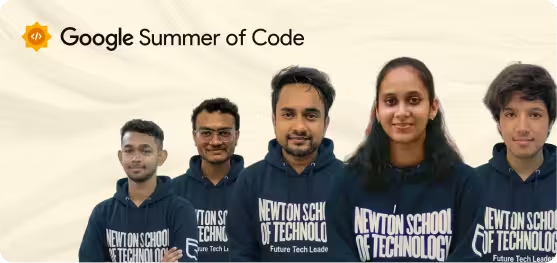
- Benefit from a strong competitive-programming culture (ICPC, Google Summer of Code) supported by mentors who understand what excellence looks like.
The result is a feedback loop: academic faculty build the foundations, industry mentors connect those foundations to what the market actually rewards.
Why this blend matters for outcomes
The faculty-and-mentor structure is closely tied to NST's results. Early, paid internships (around 93% of students intern by their second year) and selections for programs like GSoC don't happen by accident — they're downstream of teaching that keeps one foot in research and one foot in industry. When the people guiding you have recently worked at the companies you want to join, the gap between "what I learned" and "what I'm hired to do" narrows considerably.
Frequently asked questions
Where are NST's faculty from? NST's academic faculty are drawn from institutions such as IISc, the IITs, and global PhD programs, complemented by industry mentors from leading technology companies.
Do industry professionals actually teach at NST? Yes. NST's model pairs academic faculty with mentors who have held senior roles at companies like Google, Microsoft, Amazon, Adobe, and Goldman Sachs, integrated into project-based learning.
Is mentorship at NST ongoing or occasional? It's continuous. Mentorship is built into the curriculum, with feedback during projects and guidance through internships and placements, rather than limited to occasional sessions.
How does NST's faculty model differ from a traditional college? Traditional programs often rely heavily on theory-focused faculty. NST deliberately blends research-grade academic faculty with practitioners who have recent, hands-on industry experience.
The bottom line
NST's faculty answer is intentional: research-grade academics from IISc, the IITs, and global PhD programs to build the foundations, plus seasoned industry mentors from top tech companies to keep learning tied to reality. For a student who wants to be genuinely job-ready — not just exam-ready — that combination is the point.
Faculty and mentor affiliations are based on NST's official descriptions of its program. For the latest details, see the official NST website. Last updated: June 2026.