












Key takeaways
- IIITs are well-established, government-recognised institutes with strong brand equity, public-funded fee structures (especially the older IIITs), and admission largely through JEE Main.
- NST is a newer, industry-led B.Tech in CS & AI (founded 2023) with a build-first curriculum, mandatory paid internships, and a UGC-recognised degree awarded by partner universities.
- Neither is universally "better." IIITs win on legacy and brand; NST positions itself on industry alignment, early internships, and an AI-native curriculum.
- The right choice depends on your priorities: established prestige vs. hands-on, outcome-first training.
First, a quick note on what each one is
IIITs (Indian Institutes of Information Technology) are a group of institutes specialising in IT and related fields. The older IIITs (such as Hyderabad and Allahabad) carry strong reputations, established research, and large alumni networks. Admission is competitive and primarily through JEE Main, with seats allotted via centralised counselling.
Newton School of Technology (NST) is a four-year, fully residential B.Tech in Computer Science & Artificial Intelligence, founded in 2023. Importantly, NST is an industry-skilling brand of Incanus Technologies Pvt. Ltd. — not a standalone university. The degree itself is UGC-recognised and awarded by NST's partner universities: Rishihood University (Delhi NCR), Ajeenkya DY Patil University (Pune), S-VYASA University (Bengaluru), and St. Mary's University (Hyderabad). NST designs the curriculum, faculty, mentorship, and placement support. Admission is through NST's own entrance test, the NSAT.
Side-by-side: the honest comparison
Where IIITs hold a clear edge
It would be misleading to gloss over the genuine strengths of IIITs:
- Legacy and recognition. Decades of alumni, established placement records, and instant name recognition with recruiters and families alike.
- Research depth. The older IIITs in particular offer strong research programs and academic rigour, valuable if you're aiming for higher studies or research roles.
- Cost (at public-funded IIITs). Fee structures at the older, government-funded IIITs can be lower than many private options.
- A known, standardised path. JEE Main is a transparent, widely understood route.
If your priority is the assurance of an established brand and a research-oriented environment, an IIIT is a strong, sensible choice.
Where NST positions itself differently
NST's pitch isn't "we're a more prestigious college." It's "we're built around industry outcomes from day one." Its distinctive features include:
- Build-first learning with coding from week one, progressing to ML and advanced AI.
- Mandatory paid internships, with ~93% of students interning by their second year at an average stipend of ₹23,066.
- Industry mentorship from people who've held senior roles at Google, Microsoft, Amazon, Adobe, and Goldman Sachs.
- An AI-native curriculum updated continuously to track a fast-moving field.
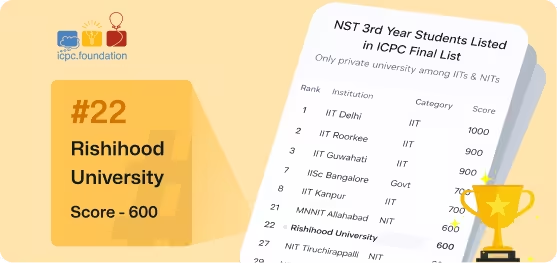
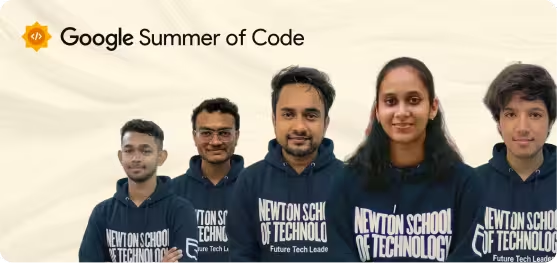
- Distinctive extras — a MacBook for every student, funded global immersion trips, a ₹1 crore "StartX" student startup fund, and a strong competitive-programming culture (ICPC, GSoC).
The trade-off to weigh: NST is new. It doesn't yet have the decades of alumni or the established brand of the older IIITs. What it offers instead is a tightly industry-aligned model and a recognised degree through its university partners.
So, which should you choose?
Rather than declaring a winner, here's a more useful framing:
- Lean toward an IIIT if established brand prestige, research opportunities, a centralised JEE-based admission path, and (at public IIITs) lower fees matter most to you.
- Consider NST if you want to code from day one, value early paid internships and real-world projects, want an explicitly AI-native curriculum, and are comfortable in a fast-paced, build-heavy environment — while still getting a UGC-recognised degree.
Many strong students will get into neither their top IIIT nor stop considering NST; the realistic decision is often between a specific IIIT seat you can actually get and what NST offers. Compare the concrete options in front of you, not the idealised version of either.
Frequently asked questions
Is the NST degree valid like an IIIT degree? NST's degree is a UGC-recognised B.Tech awarded by its partner universities. IIITs award their own degrees. Both are recognised qualifications, though the awarding bodies differ.
Is NST harder to get into than an IIIT? They use different filters. IIITs rely mainly on JEE Main rank; NST uses the NSAT (and a coding-focused variant), which tests problem-solving ability. "Harder" depends on your strengths.
Does NST place students as well as IIITs? NST reports strong early internship outcomes (~93% by year 2) but is a newer institution without the decades-long placement track record of established IIITs. Compare current, verified data for the specific campuses you're considering.
Can I choose NST if I miss a top IIIT? Yes — many NST applicants are JEE aspirants who narrowly missed a preferred seat and want an outcome-first alternative with a recognised degree.
The bottom line
This isn't a rivalry with a single right answer. IIITs offer established prestige and research depth; NST offers an industry-led, build-first model with early paid internships and a recognised degree. Map each against your own priorities, finances, and the actual seats available to you — and the better choice for you will become clear.
This comparison is intended to be balanced and informational. Verify current fees, admission criteria, and outcomes on official sources before deciding. Last updated: June 2026.